Build Awareness with HubSpot AEO
SEO is about ranking higher so buyers can find you. AEO is about being cited when AI answers buyers' questions. Same goal but a different channel, different mechanics, and a different playbook.
HubSpot AEO gives marketers the visibility, the strategy, and the execution tools to win that channel. All in one place.
Core features in HubSpot AEO(Answer Engine Optimisation)
-
Brand Visibility Dashboard
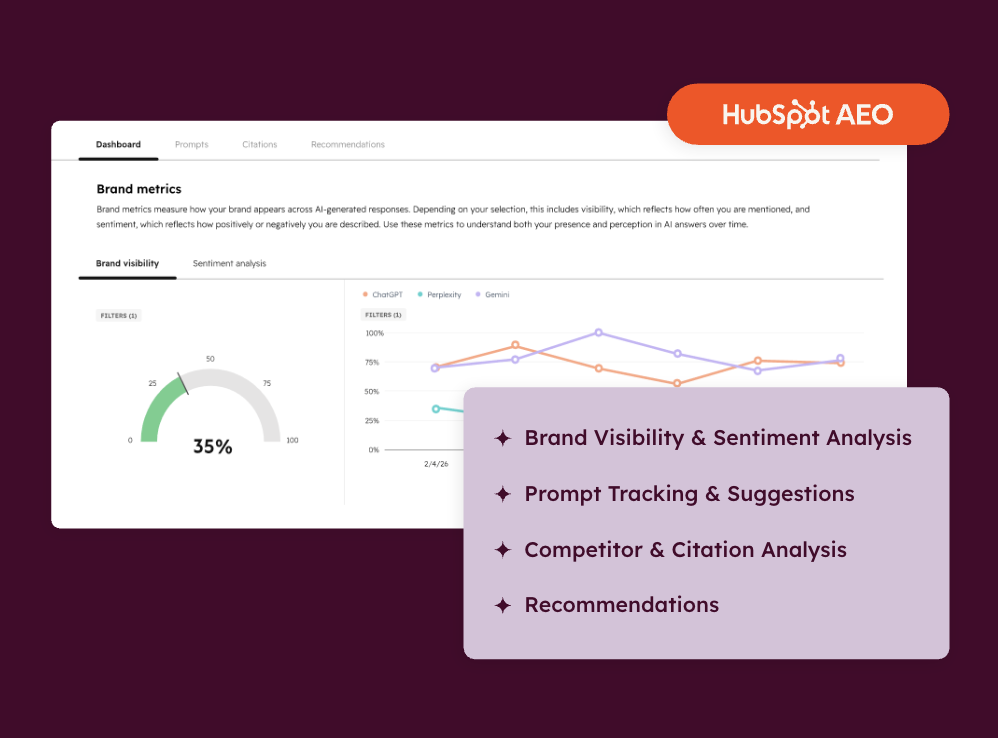
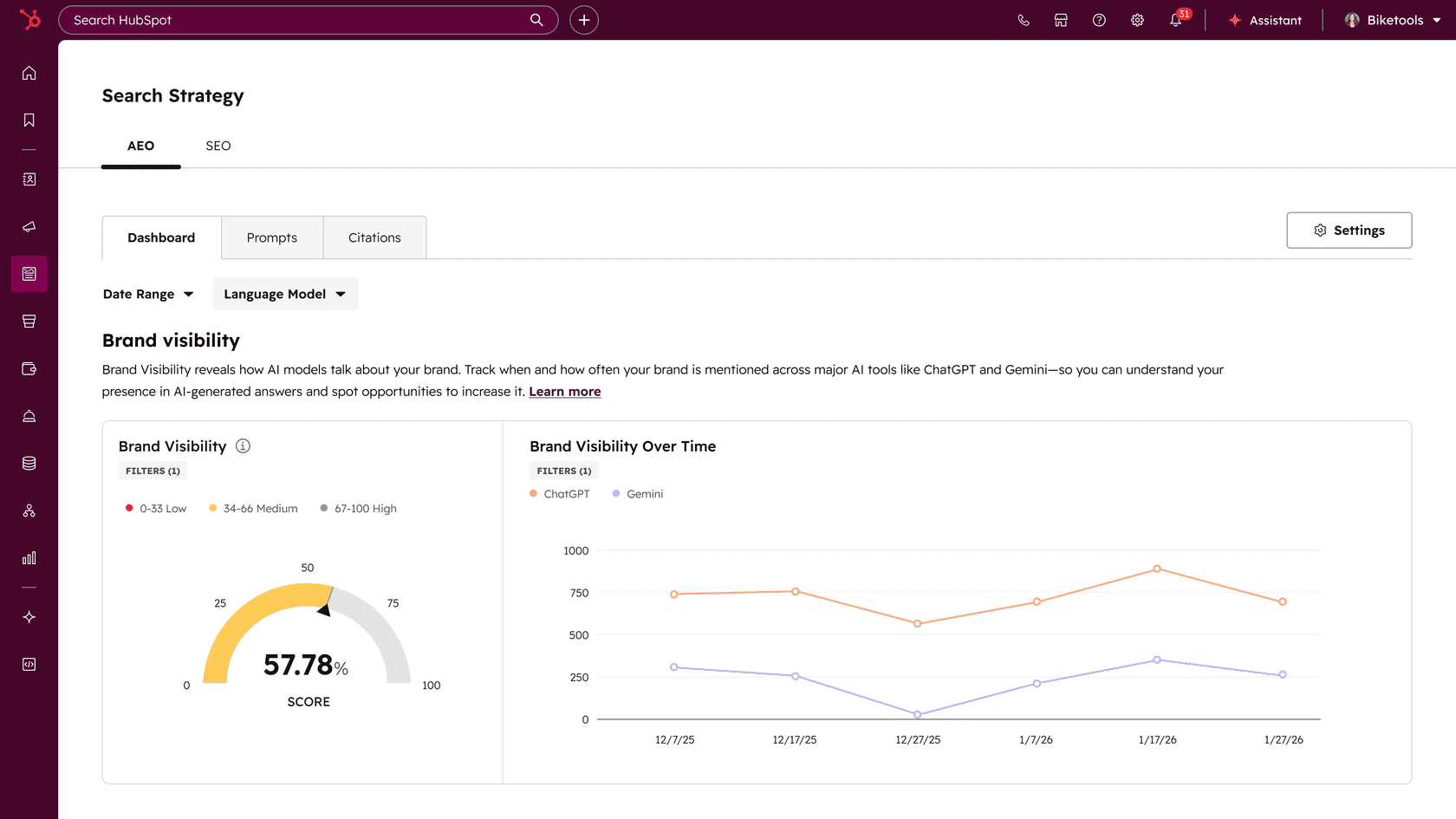
The Dashboard is the first thing you see when you open AEO, and it gives you a clear read on how your brand is performing across AI platforms. Think of it as your top-level scorecard.
The main metric is your Brand Visibility score: the percentage of your tracked prompts where your brand shows up in the AI's response. If you're tracking 10 questions your customers might ask, and your brand appears in 7 of those answers, your score is 70%. You can see this broken out by answer engine (ChatGPT, Perplexity and Gemini), and tracked over time so you can see whether things are improving.
There's also a Sentiment Analysis tab alongside Brand Visibility. This measures how positively or negatively your brand is described in AI-generated responses, on a scale from -100% to +100%. Knowing your visibility score is useful; knowing that AI is describing you in a negative light is equally important, because it means there's a perception problem to address, not just a visibility one.
-
Competitor Analysis
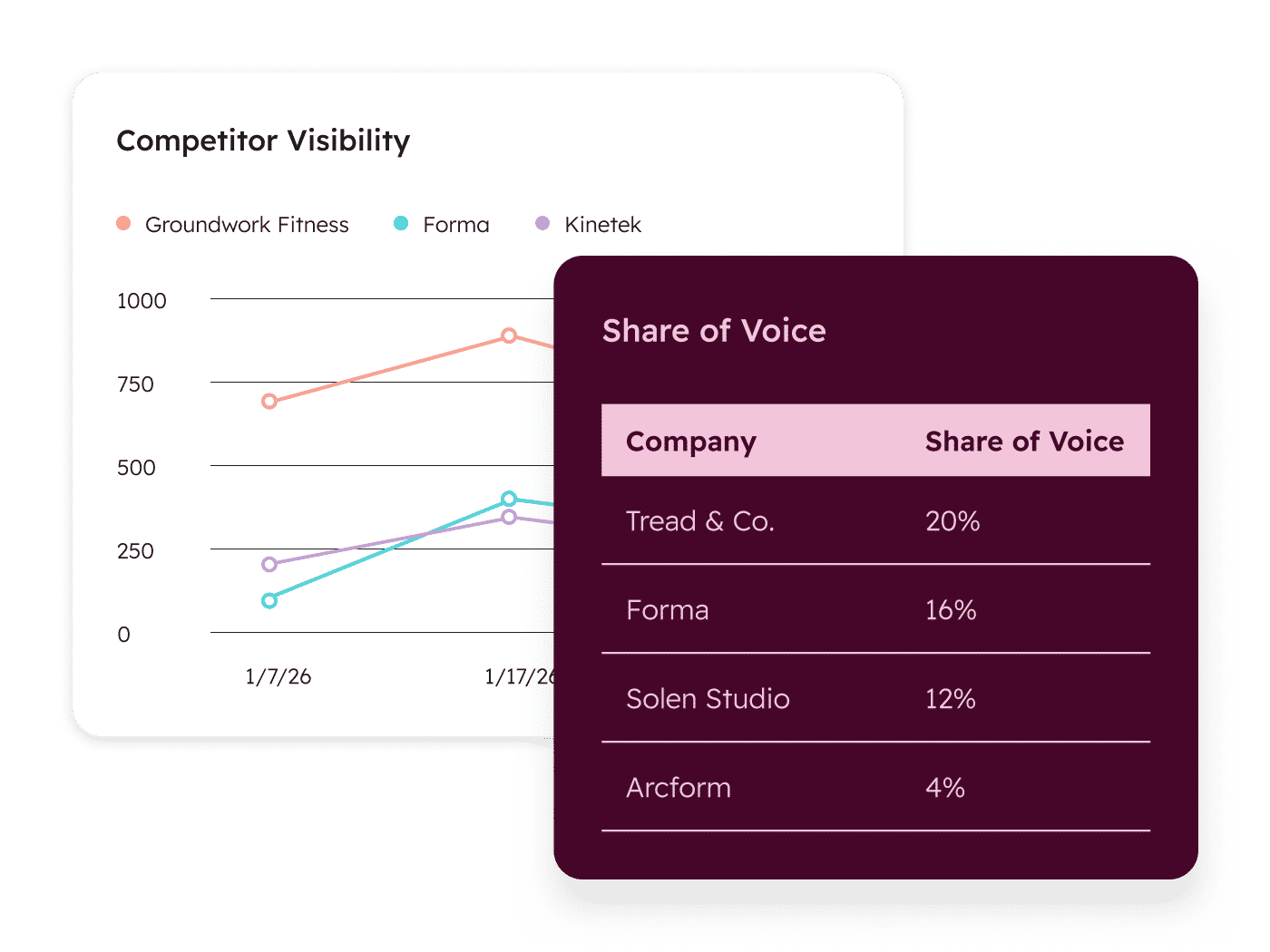
The dashboard also includes a Competitor Landscape section, which shows your Share of Voice relative to competitors.
This tells you not just whether you're showing up, but how prominently you're showing up relative to the competition. If there are 100 total brand mentions across you and your competitors and 25 are yours, your Share of Voice is 25%.
-
Multi-Engine Support
Track visibility across three major AI engines: OpenAI (ChatGPT), Perplexity, and Gemini.
More LLMs like Google AI Mode and AI Overviews will be added throughout the year. -
Prompt Tracking & Suggestions
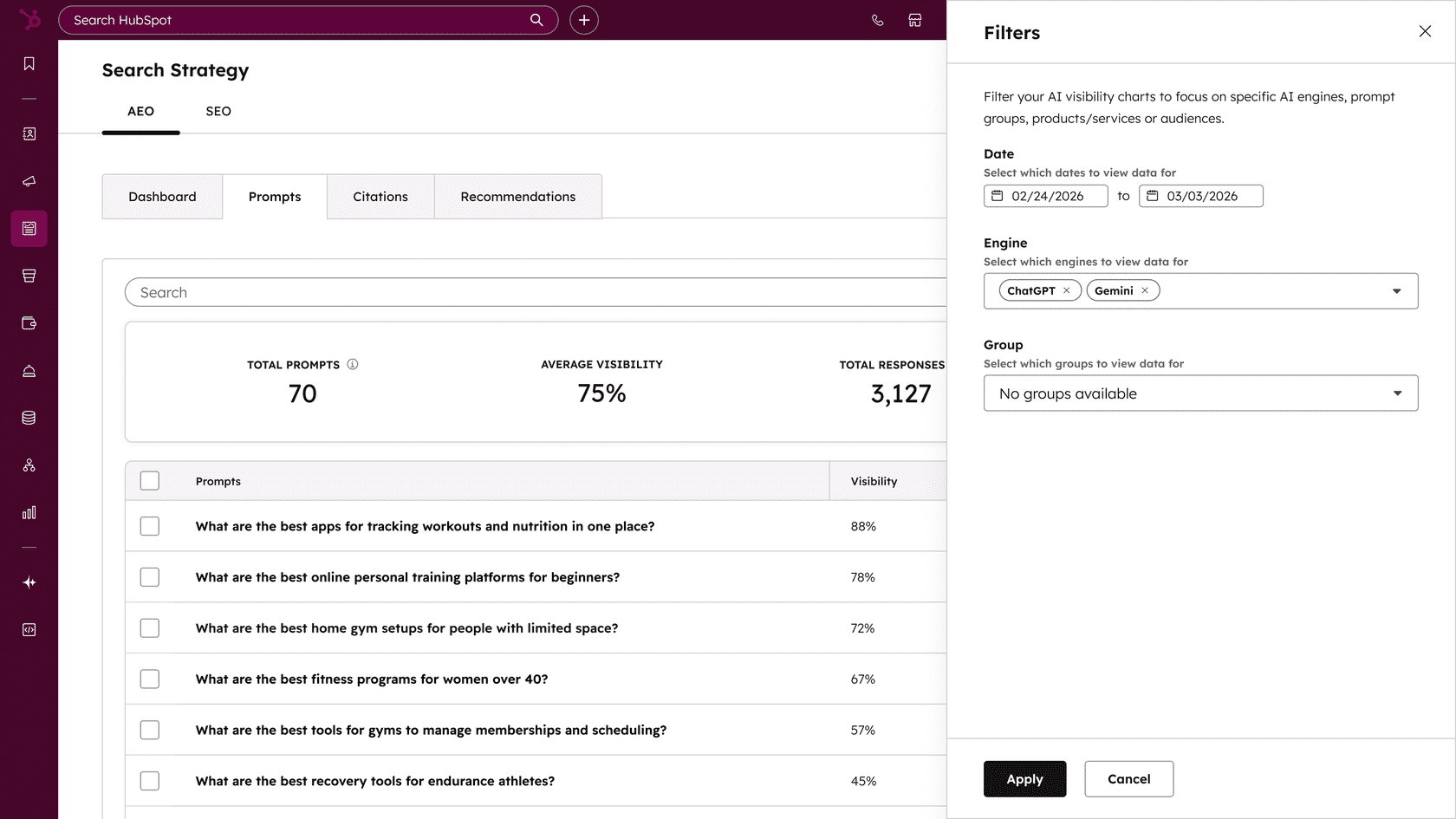
Prompts are the questions you want to monitor, things like "What are the best running shoes for long distance?" or "Which CRM is best for small businesses?" These are the kinds of questions your potential customers are typing into ChatGPT and Gemini right now. The Prompts tab is where you manage which questions you're tracking and see how your brand performs on each one.
For every prompt, you can see your visibility score for that specific question, and click into it to see the actual response the AI generated, how your visibility on that prompt compares to competitors over time, and prompt-level recommendations for how to improve your visibility on that specific question.
You can add your own prompts manually, or get AI-powered suggestions based on what HubSpot already knows about your business from your CRM data. This matters because most AEO tools make you guess which prompts to track. HubSpot uses the context it already has about your business to suggest prompts that are actually relevant to you, not just generic industry questions.
You can also organise prompts into Groups by product line or customer segment, which makes it easier to analyse performance for a specific part of your business rather than looking at everything as one big pile.
-
Citation Analysis
When an AI like ChatGPT answers a question, it pulls from sources across the web to inform its response. Those sources are citations, and they matter a lot: the content getting cited is the content shaping what AI says about your category, your competitors, and your brand.
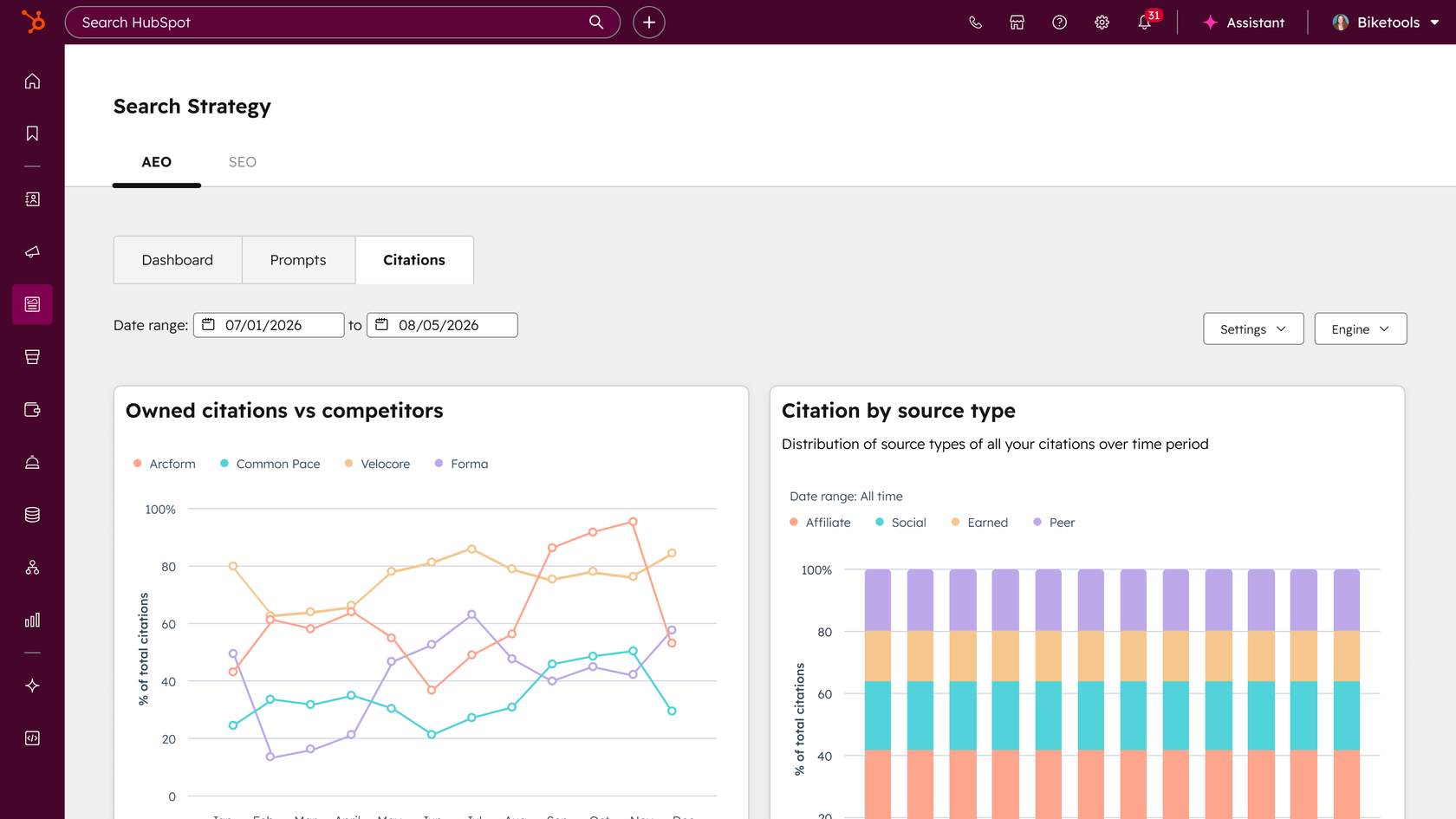
The Citations tab breaks down exactly which sources AI is pulling from, organised in a few different ways. You can see which content types are most commonly cited (listicles, blog posts, product pages, news articles, etc.), which channels those citations come from (your own website, earned media, review sites, user-generated content like Reddit, and so on), and which specific domains are getting cited most often.
There's also a competitive view: you can see how often AI is citing your website versus competitors' websites, and how often your brand is mentioned across citations overall, including third-party sources that you don't own or control.
This is the data that tells you where to focus. If listicles dominate the citations for your key prompts, that's a signal to prioritise getting your brand featured in that format. If a particular domain keeps appearing, that's a partnership worth pursuing. You stop guessing and start working from actual data.
-
Recommendations
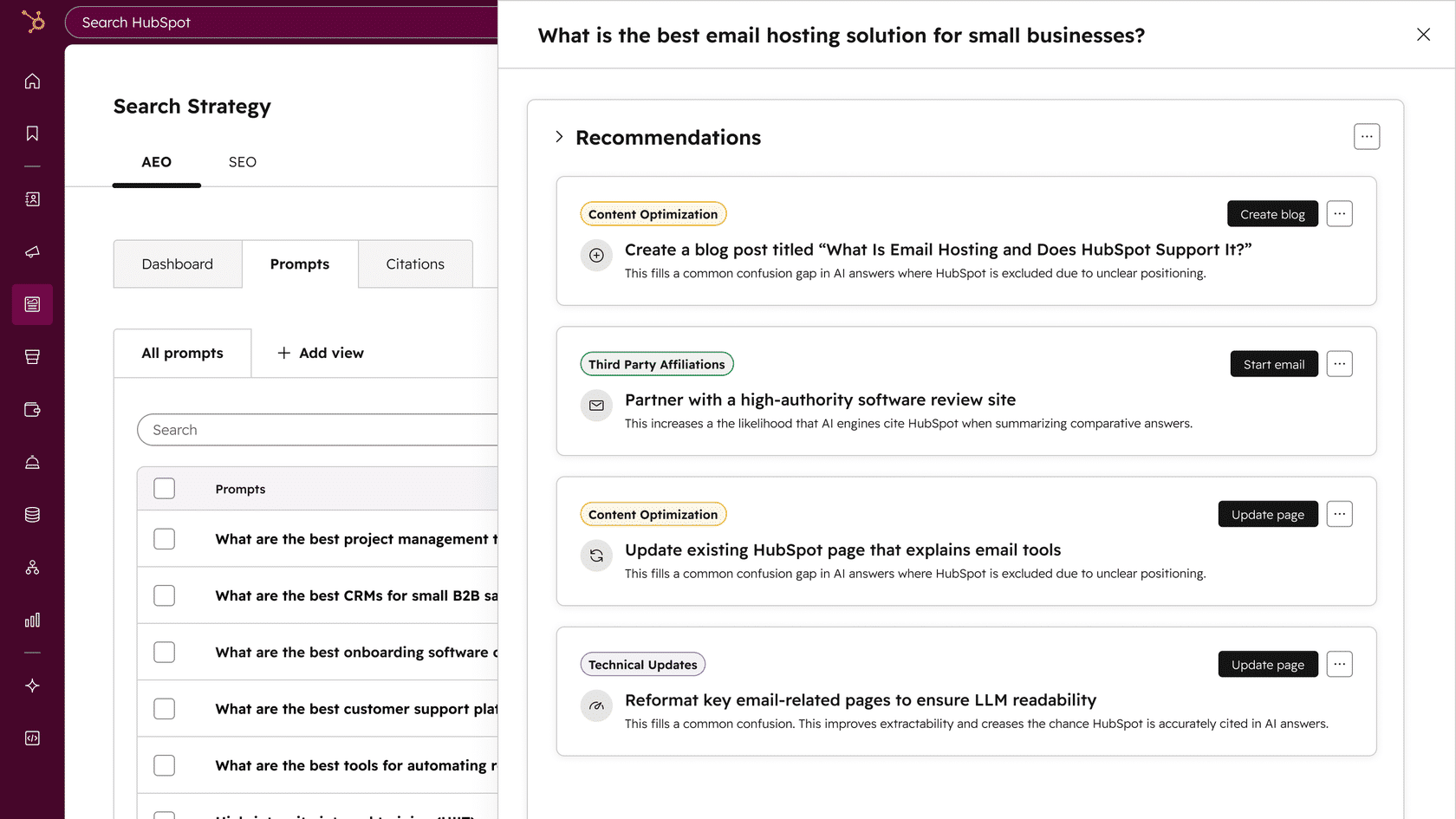
Recommendations is where the data turns into a concrete action plan. Based on everything the tool has analysed across your prompts and citations, it generates a prioritised list of specific things you should create or do to improve your visibility.
Each recommendation comes with a full content brief: a suggested title, a summary of what the content should cover, the target audience it's written for, and primary and secondary keywords to include. You can also see exactly why that recommendation was generated. The "What's driving this recommendation" section shows you the associated prompts, the content type distribution that led to the suggestion (for example, if 71% of citations for a given prompt are listicles, the tool recommends you create a listicle), and the specific URLs being cited most often for that topic.
This gives you enough context to understand the reasoning, not just the output.
Why HubSpot AEO?
There are other AEO tools out there. Profound, Scrunch, and other visibility monitors share many of the same core features: prompt tracking, citation analysis, visibility scores. So why HubSpot?
The challenge with every standalone AEO tool is the same: they start from scratch, and they stop at the report.
When you set up tracking in a point solution, you're guessing. You're entering broad categories and generic industry questions that may or may not reflect how your actual buyers talk about your business. You get a visibility score, a list of recommendations, and then you're on your own to figure out how to act on them.
That's a broken workflow. And the more manual it is, the less likely it gets done.
Here's What Makes HubSpot's AEO Tool Powerful
-
Better Input: More Relevant Prompts
AEO in Marketing Hub automatically suggests prompts based on CRM context, your industries, customer segments, competitors, and content , from day one. This means your visibility data reflects your actual buying journey, not generic questions that may not drive meaningful outcomes.
-
Better Output: More Specific Recommendations
More relevant prompts produce more accurate data, which produces more targeted recommendations. When the tool tells you to create content or update a page, that guidance is grounded in real business context, not guesswork. Recommendations improve as your CRM data grows.
-
Better Execution: Insight and Action in the Same Place
AEO doesn't just show you the gap, it helps you close it without leaving HubSpot. When AEO surfaces a content gap, you can act on it immediately using HubSpot's content tools: Blog, Webpages, Content Remix, Breeze Social Agent, and more.
Plus, with the new Reddit integration and TikTok integration, you have the ability to show up in more places where AI is looking. Everything in one place.
No juggling multiple point solutions or handoffs.
Our AEO Services
We provide an end-to-end AEO program from strategy to execution. We'll help you:
-
Measure: tracking visibility across AI
-
Diagnose: identify prompt and citation gaps and opportunities
-
Influence: create, optimize & distribute content across:
-
Owned media (blog, website)
-
Earned media (PR, communities)
-
Social (LinkedIn, YouTube, TikTok)
-
-
Amplify: drive engagement and mentions externally
-
Iterate: Use HubSpot insights to refine their strategy
AEO Audit
This includes:
-
Brand visibility analysis across AI engines
-
Prompt landscape mapping (what buyers ask AI)
-
Competitor AEO benchmarking
-
Citation/source analysis (where AI pulls from)
-
Content gap + authority gap analysis
AEO Setup & Configuration
-
Prompt strategy development (aligned to ICP + funnel stages)
-
Tracking setup inside HubSpot AEO
-
Content strategy mapped to AI prompts
-
Entity/brand positioning strategy
-
Initial optimisation of key pages/content
AEO Management
-
Ongoing prompt expansion + tracking
-
Content creation + optimisation
-
Citation acquisition strategy
-
Competitive monitoring + response strategy
-
Performance reporting (visibility trends, share of voice)